
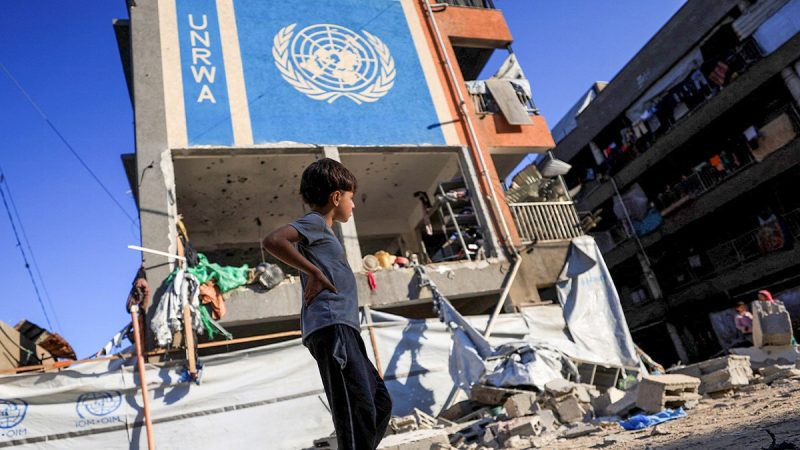
UNRWA officials urged congressional staffers to oppose a potential Trump administration move to designate the U.N. agency as a foreign terrorist organization, and discussed UNRWA’s ongoing operations in Gaza and the West Bank, including cash-based assistance, during a Dec. 17 briefing, Fox News Digital has learned.
The video conference was organized by UNRWA USA, the American nonprofit that supports the agency through advocacy and fundraising. UNRWA USA Executive Director Mara Kronenfeld opened the briefing by saying the goal was to make clear that UNRWA ‘is still on the ground’ in Gaza and the West Bank despite what she described as ‘the Netanyahu government’s insidious efforts to systematically prevent UNRWA from continuing its life-saving humanitarian work.’
During the meeting, briefers also raised reports that the U.S. government was considering designating UNRWA as a foreign terrorist organization and discussed with congressional offices what steps could be taken to ‘help prevent that and support UNRWA in its critical work,’ according to meeting details reviewed by Fox News Digital.
Bill Deere, UNRWA’s director in Washington, said ‘press reports appear to be true’ that the administration was considering a foreign terrorist organization designation for the agency.
‘This would be unprecedented for a U.N. agency to consider this. It is certainly unwarranted,’ Deere said, asserting that ‘four separate independent investigations’ dispute Israel’s allegations regarding UNRWA’s workforce.
Deere urged congressional offices to respond forcefully.
‘You can loudly express your displeasure,’ Deere said, arguing that the ramifications would extend beyond UNRWA and set a precedent affecting the broader U.N. system.
‘If they go ahead and do this, our recourse with regard to this is limited,’ he said, adding that one step that could be taken is that ‘Congress can override the designation.’
The meeting featured UNRWA field leadership describing conditions and operations in Gaza and the West Bank.
Sam Rose, director of UNRWA affairs in Gaza, told participants that international staff were not entering Gaza because of the Israeli Knesset legislation, and that operations were being managed remotely.
Rose said that despite claims that UNRWA has been blocked, the agency’s services in Gaza haven’t stopped for a single day, pointing to primary healthcare, education, water and sanitation work, shelter operations and the use of UNRWA facilities as emergency shelters.
Rose also described the agency’s ability to operate programs that do not rely on immediate supply deliveries.
‘Cash assistance and job creation programs are also able to continue,’ he said and added, ‘we’re able to operate at scale.’
Roland Friedrich, introduced as director of UNRWA affairs in the West Bank, described UNRWA’s scale in the territory, including education, healthcare and assistance programs. He said UNRWA provides support to hundreds of thousands of Palestinian refugees, including aid that ‘can be cash assistance,’ along with other forms such as food vouchers and social protection payments.
Friedrich also described ‘cash for rent’ assistance for displaced people, and argued that UNRWA’s presence plays a stabilizing role across multiple countries in the region.
The officials also discussed workarounds that allow UNRWA to keep operating under restrictions.
Rose said UNRWA was still able to receive fuel and that certain coordination occurred through third parties, describing indirect engagement involving U.N. channels. He said fuel could run power generators and water pumps and emphasized the importance of keeping basic services running.
On aid flows, Rose said Israel was reporting truck numbers that reached 600 per day, and he said he did not have reason to doubt the overall count. At the same time, he argued that the mix of goods entering had shifted, with commercial supplies playing a larger role while certain humanitarian items remained restricted for U.N. agencies. He described what he called a two-tier system, where some items blocked from U.N. use could enter through private channels.
Beyond the operational discussion, the briefing included explicit advocacy aimed at congressional offices.
Kronenfeld urged participants to support legislation described in the meeting as the UNRWA Funding Emergency Restoration Act of 2025, and she thanked offices already backing efforts to restore U.S. funding, describing the United States as historically UNRWA’s largest donor before the funding halt in 2024.
UNRWA USA did not respond to multiple requests for comment from Fox News Digital. UNRWA also did not respond.
William Deere, director of the UNRWA Representative Office in Washington, D.C., provided the following statement in response to a request for comment from Fox News Digital:
‘UNRWA participates in briefings hosted by the UNRWA USA National Committee and attended by bicameral groups of Republican and Democratic staff from Capitol Hill, as well as think tanks and nongovernmental organizations. Briefings like these are important opportunities for the Agency to respond to the government of Israel’s ongoing disinformation campaign suggesting that UNRWA is no longer actively working in Gaza. Quite the opposite is true. Every day, UNRWA staff are delivering critical services in Gaza and the West Bank, including East Jerusalem. In fact, in a recent letter to the U.S. Government Accountability Office, UNRWA thanked President Trump for negotiating the ceasefire, which allows the world to turn to Gaza’s future.’
Deere added: ‘In Gaza, UNRWA medical personnel deliver 40 percent of primary healthcare and play a critical role in distributing water, promoting public health through immunization campaigns, pest control, nutrition screenings, and the disposal of solid waste. UNRWA is also leading the way in Gaza education, stepping up its ‘back to learning’ program, with almost 70,000 children now accessing the Agency’s in-person learning activities. The West Bank, including East Jerusalem, is also a challenging area in which to work, especially given the various laws approved by the Israeli Knesset, and policymakers are always interested to hear the impacts of these laws firsthand from our experts.’
